Syria
29 Jul 2026


The Starvation Mobile Justice Team (SMJT) started its mission in January 2023, as part of the EU, UK and US-funded Atrocity Crimes Advisory (ACA) group. This team includes senior international and Ukrainian prosecutors and investigators with expertise in starvation-related crimes, collaborating with OSINT experts to leverage cutting-edge innovation in the investigation of these crimes. The SMJT was created as a response to the increasingly clear, urgent need to investigate starvation related crimes in Ukraine. Since its inception, the SMJT has delivered ground breaking investigative findings, public-facing reports and crucial technical assistance to the Office of the Prosecutor General (OPG), Regional Prosecuting Offices (RPOs) and other key stakeholders. During 2024, the SMJT expanded its work under the three thematic pillars: (i) the siege of Mariupol (assessing this primarily through the lens of humanitarian access violations); (ii) grain theft and the potential qualification as and legality of a naval blockade of the Black Sea Ports in the context of starvation; and (iii) patterned analysis, focussing on attacks against critical infrastructure, notably attacks on grain and port-related infrastructure utilised for export within Odesa Oblast.


The Starvation Training Manual
Release of the Special Issue Ukraine edition of the Starvation Training Manual (available in Arabic and Ukrainian), and the Mobile App, the first of its kind on the market.

StoryMap
Release of a comprehensive StoryMap presenting the high-level findings of SMJT investigations into Russian forces’ use of starvation tactics, and the weaponisation of food and other OIS against Ukrainian civilians.

Harvesting Conflict
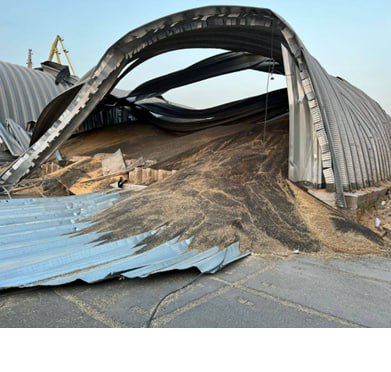
Harvesting Conflict. Unlawful Attacks against grain and related infrastructure in the Odesa Oblast

The Architecture of Starvation
The Architecture of Starvation. Seven Years on From UNSC 2417: Operationalising the Prohibition of Starvation under International Law and Policy
The project was established with the support of the Kingdom of the Netherlands. To collect information and for cooperation purposes, GRC engaged with a broad range of Ukrainian governmental and non-governmental organizations, as well as international human rights institutions. These include, but are not limited to: the Office of the Prosecutor General, the Chernihiv, Mykolaiv, and Donetsk Regional Prosecutor’s Offices, the Central Investigative Office of the Security Service of Ukraine, the Security Service of Sumy Region, the Interagency Working Group of Military Experts, the International Criminal Court, the UN Commission of Inquiry on Ukraine, the European Union Advisory Mission Ukraine, the World Food Programme, Open Society Foundations Justice Initiative, eyeWitness to Atrocities, Mnemonic Ukrainian Archive, the International Committee of the Red Cross, the Ukrainian Red Cross, the Mariupol City Administration, the National Police of Ukraine, the National Guard of Ukraine, the Ministry of Infrastructure of Ukraine, the Centre for Civic Initiatives “Eastern Gate,” the charitable foundation “I am Mariupol,” and many others.
Syria
29 Jul 2026
Ukraine
21 May 2025