

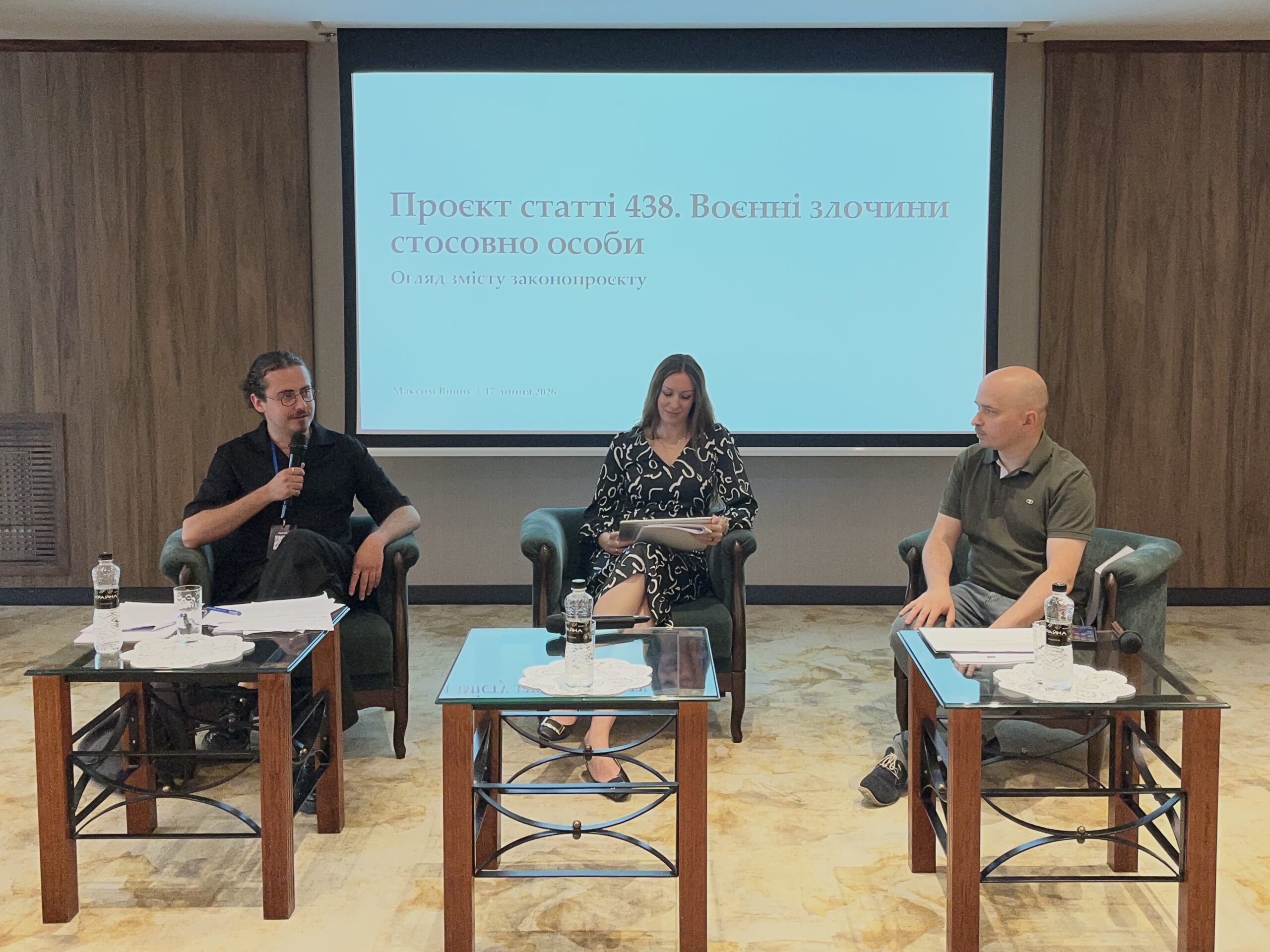
Last week, Maksym Vishchyk, Mobile Justice Team Lead and Legal Research Coordinator at Global Rights Compliance (GRC), participated in the Ukrainian Week of International Criminal Justice, organised by the Centre for Civil Liberties.
As part of the conference “A Decade of Attempts and Mistakes: Challenges and Prospects for Harmonising Ukraine’s Criminal Legislation with International Criminal Law”, Maksym spoke during the second day’s programme, which focused on the presentation of the draft law prepared by the Interagency Working Group under the Office of the Prosecutor General to complete the harmonisation of Ukraine’s Criminal Code with international criminal law.
During Workshop 1, titled “Analysing the Draft Law: War Crimes Against Persons”, Maksym presented key aspects of the proposed amendments concerning war crimes against persons, exploring the structure of the draft provisions, their relationship to international humanitarian and criminal law, and the rationale behind several proposed changes.
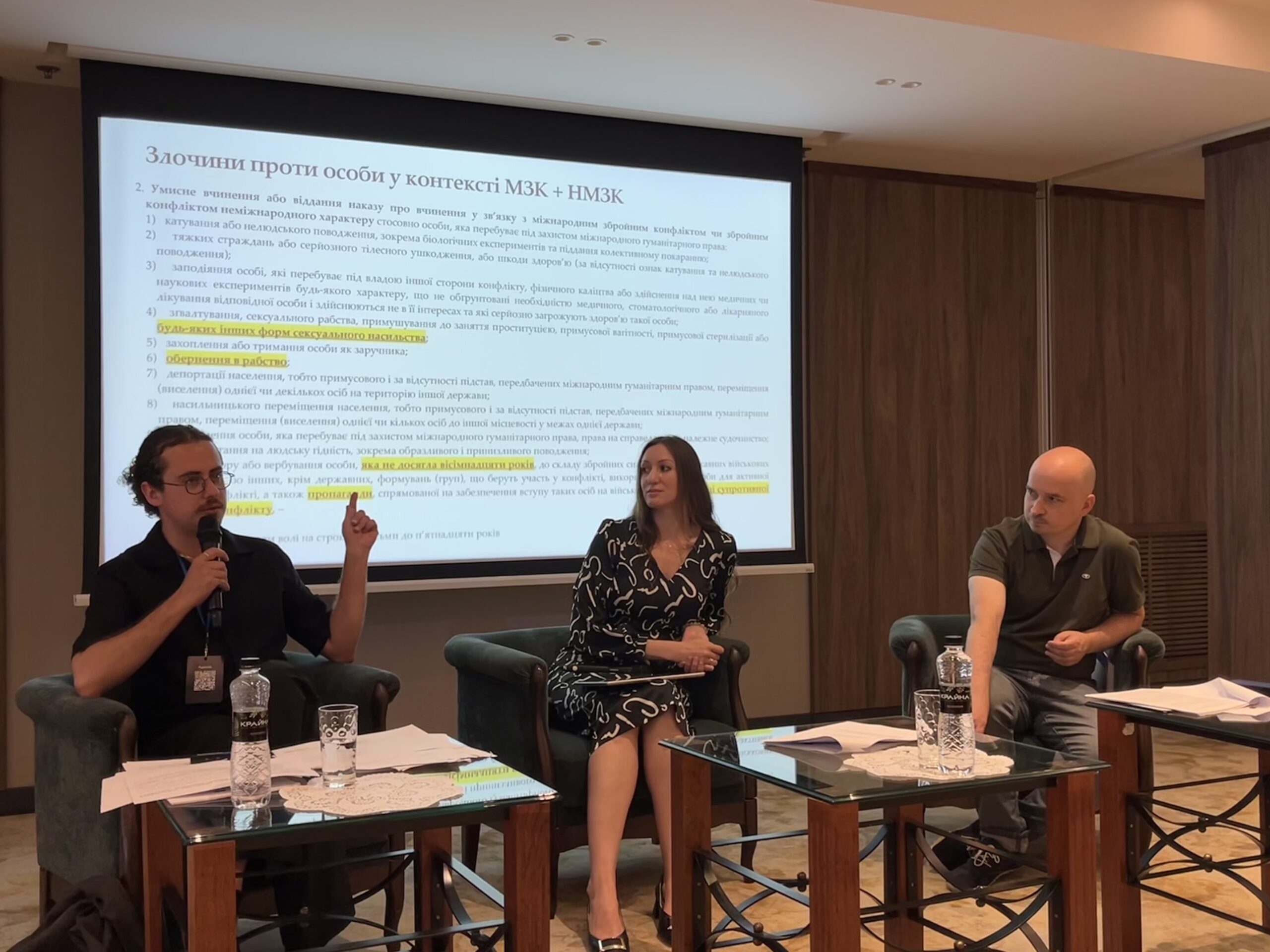
As part of his remarks, Maksym highlighted the collaborative process behind the draft law, emphasising that meaningful legal reform depends on bringing together diverse expertise and perspectives.
“The work of the Interagency Working Group on this draft law has been exemplary in the context of Ukraine. It has been a model of genuine cooperation between civil society, state institutions, including law enforcement authorities, and academia.”
A part of Maksym’s intervention was dedicated to the analysis of novel issues proposed by the draft law, particularly those concerning forced passportisation.
“When we build prosecutorial strategies concerning war crimes, we must always ask ourselves whether our approach accurately reflects the true nature of policies that Russia is pursuing in occupied territories. It is not in the interest of the justice system to prosecute every single isolated incident. The strategic objective is to address the policies that drive atrocity crimes more broadly. In this respect, criminalisation of forced imposition of nationality by an occupying power serves this very objective – not only does it meet the seriousness threshold for war crimes under international law, but its criminalisation is also inherent to depict the true essence of Russia’s criminal plan and policy tied to annexation,” noted Maksym.