

New evidence exposes Russia’s systematic economic warfare in coordinated attacks against Black Sea and Danube ports.
Read the report here.
Read the summary here.
News Highlights:
- New report exposes Russia’s systematic campaign to destroy Ukraine as a global agricultural powerhouse
- Deliberate pattern of attacks against grain and related infrastructure in Odesa Oblast at the centre of the investigation
- Over 101,000 square metres of grain storage obliterated by Russian forces
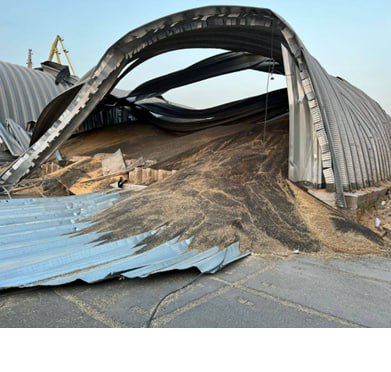
- In one single attack – 60,000 tonnes of grain were hit in Chornomorsk – the equivalent of approximately 2,000 30ft long articulated lorries full of grain destroyed in a single attack
- Attacks against the Port of Reni and Orlivka reportedly resulted in multiple casualties
- Calculated use of highly precise drones and missiles demonstrates Vladimir Putin’s economic ambitions in Ukraine
- Military targets avoided at the expense of grain infrastructure
- Vladimir Putin linked to attacks via use of weapons requiring highest authorisation
- 321 port infrastructure facilities damaged since July 2023 according to President Zelenskyy
- 113 additional attacks taken place since investigation concluded
- Investigation driven by cutting edge open-source intelligence and maritime tracking data to identify perpetrators
- Public statement from Russian government officials and Russian media confirm calculated intent of attacks
- ‘Without the Black Sea ports, Ukraine simply does not exist’ – Russian propagandist
- Groundbreaking report to build on upcoming confidential submission to the ICC and the UN
- Global food insecurity in regions dependent on Ukrainian grain exacerbated by attacks
[London: 21 May 2025]: Today, a new report released by international human rights foundation, Global Rights Compliance, has revealed significant evidence highlighting an orchestrated Russian campaign to dismantle Ukraine’s agricultural economy by crippling its grain export capabilities and destroy its position as a top grain exporter worldwide.
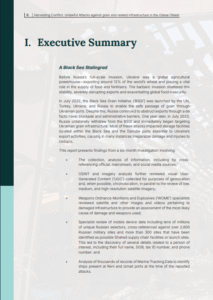
‘Harvesting Conflict’ produced by Global Rights Compliance’s Starvation Mobile Justice Team, is the result of a six-month investigation, in collaboration with UK based intelligence company Intelligence Management Services Limited and Centre for Information Resilience, into a pattern of attacks against grain and related critical agricultural infrastructure in Ukrainian ports and other facilities located in the Odesa Oblast.
Global Rights Compliance’s Starvation Mobile Justice Team (SMJT) is part of the UK, EU and US-sponsored Atrocity Crimes Advisory Group (ACA) which was launched in response to the need of the Office of the Prosecutor General (OPG) to increase capacity to investigate and prosecute atrocity crimes perpetrated since the invasion by Russian Forces of Ukraine. The SMJT is funded by the Kingdom of the Netherlands.
Analysis by the Starvation Mobile Justice Team exposes Moscow’s systematic use of economic warfare, concentrating on nine attacks launched by Russian forces against grain and infrastructure sites situated across multiple Black Sea and Danube ports and other facilities within the Odesa Oblast following Russia’s withdrawal from the Black Sea Grain Initiative (BSGI) in July 2023.
The report reveals Russia’s economic objective to replace Ukraine as a top grain exporter worldwide, attacking Ukraine’s agricultural sector as a key source of national revenue, and dismantling a Ukrainian way of life. The widespread and coordinated kinetic attacks on grain and grain-related infrastructure in Odesa Oblast increased exponentially after Russia’s withdrawal from the BSGI.
Over 101,000 square metres of grain storage alongside machinery crucial for the functioning of the grain export infrastructure were hit across the region between July and October 2023 in the attacks analysed by the Starvation Mobile Justice Team.
These actions have severely disrupted Ukraine exports and exacerbated global food insecurity, particularly in regions heavily dependent on Ukrainian grain, which accounted for around 12% of the world’s wheat before Russia’s full-scale invasion in 2022.
The report finds that high-level Russian officials alongside numerous prominent Russia-owned media outlets and propagandists during and in the aftermath of the attacks display clear support for the targeting of these civilian objects and their importance to Ukraine.
On 21 July 2023, Vladimir Solovyov, a Russian official state-sponsored propagandist stated that “[T]he war for them [the Black Sea ports] will be waged […] without any mercy. […] for the Western coalition, Odessa, Nikolaev and Izmail are a kind of Stalingrad. Without the Black Sea ports, Ukraine simply does not exist […].” Vladimir Putin himself declared Russia’s readiness to replace Ukrainian grain exports, underlining a broader campaign of economic warfare on 27 July 2023.[i]
The report highlights another case of intent signalled by a Kremlin mouthpiece following attacks against the port of Izmail between July and October 2023, which resulted in the damage or destruction of a staggering total of 26,687 square metres of grain storage area. A journalist of Russian State-owned media Rossiya-1, Olga Skabeyeva, defined the strikes on Izmail “predictable [as] after the cancellation of the grain deal, Russia [had] declared the northern Black Sea a Hazardous navigation zone”.
Analysis by the investigation also identified perpetrators and responsible military units through the use of a group of specialist analysts who used cutting edge technology to analyse mobile device data, including tens of millions of unique Russian selectors. These were cross-referenced against over 2,600 Russian military sites and more than 300 sites have been as possible Russian Shahed drone supply chain facilities, linking individuals to the attacks. Then cross-referenced with more traditional OSINT investigation techniques.
The report reveals that the attacks were launched using a variety of high-precision weapons designed to strike designated targets with high-accuracy, according to research by Weapons Ordnance Munitions and Explosives (WOME) specialists, highlighted in an attack on Chornomorsk between 18-19 July 2023.
The attack on Chornomorsk involved the use of multiple types of highly accurate weapons and ammunitions, including ‘Onyx’, ‘Kh-22’ and ‘Kh-59’ missiles along with high precision Shahed-136 UAV drones, showing a highly coordinated attack which would require authorisation from the Strategic Command of the Russian Armed Forces, indicating the orchestrated nature of the attack. The use of long-range aircraft in combat also requires approval from the President of the Russian Federation, confirming the direct involvement of Vladimir Putin in the attacks.
According to the new report, the strike on Chornomorsk was not driven by Russian military goals due to the absence of evidence of attacks on military objectives surrounding the grain facilities. Based on analysis of satellite imagery dated 9 October 2022, the report reveals Ukraine military forces were posted in at least seven locations, given Chornomorsk’s relevance as a major Black Sea port. However, none of the observable Ukrainian positions were in the vicinity of the area attacked on 19 July 2023, with the closest position identified located approximately 1.5 kilometres away, showing no clear military objectives in the attack.
The investigation finds that 60,000 tonnes of grain was destroyed in the attack on Chornomorsk – the equivalent of approximately 2,000 30ft long articulated lorries full of grain destroyed in a single attack – speaking to Russia’s intention to target grain facilities.
Beyond the temporal scope of the report, Russian forces continued to attack the Odesa Oblast unabated, with estimates of 113 attacks between January and October 2024 alone, targeting more ports and other critical infrastructure and showing a clear pattern against grain and related infrastructure. President Zelenskyy stated that, since July 2023, Russia has damaged 321 port infrastructure facilities alongside 20 foreign merchant vessels.
‘Harvesting Conflict’ follows Global Rights Compliance’s 2023 report ‘Agriculture Weaponised’, and foreshadows a confidential submission soon to be submitted to the International Criminal Court. The findings contribute to mounting evidence that Russia’s targeting of agriculture constitutes part of a broader strategy of aggression and destruction against Ukraine’s economy, with attacks on civilian objects and the destruction of enemy’s property not justified by military necessity and therefore evidence of war crimes.
Catriona Murdoch, Vice President and Head of Starvation Portfolio at Global Rights Compliance, said: “Given the scale and impact of these attacks on the Odesa region, international investigations must now mirror Ukraine’s national investigations and prioritise the targeting of agricultural infrastructure as a war crime. The protection of critical civilian infrastructure and food systems in conflict zones is not only a legal obligation – it is essential to safeguarding civilian populations and global food security.”
Yuri Belousov, Head of the Department for Combating Crimes Committed in Conditions of Armed Conflict, Office of the General Prosecutor, said: “Justice is not a political statement – it is a legal and moral imperative, essential to the dignity of every human being. This report forms part of a broader effort to ensure that such crimes do not go unanswered and that those who order, enable, or execute them, are held to account.
Ukraine will continue to stand firm, not only in defense of our sovereignty, but also in defense of the rule of law, the integrity of global food systems, and the basic dignity of human life. The Office of the Prosecutor General of Ukraine urges continued international attention as Ukraine enters its third year under sustained attacks on critical civilian infrastructure.”
Harvesting Conflict
Full report is available here.
Image Captions
- LHS: Odesa after Russian attack, 2023-07-19 (01).jpg – National Police of Ukraine
- Centre: President Putin – Wikimedia Commons
- RHS: Destroyed grain facility – Mgov.ua
Global Rights Compliance
Global Rights Compliance, founded in 2013, is an international human rights foundation, specialising in international humanitarian law, international criminal law and business and human rights. Global Rights Compliance’s mission is to provide justice through the innovative application of international law.
The Starvation Mobile Justice Team
Since Russia’s illegal invasion in 2022, Global Rights Compliance has been supporting Ukraine’s Office of Prosecutor General (OPG) to investigate the growing number of war crimes, including attacks on civilian infrastructure, sexual violence, murder and child abductions.
The Starvation Mobile Justice Team is made up of a combination of expert lawyers, OSINT researchers, and military experts, and has been focussing on starvation-oriented war crimes. The team has assisted several well-known investigations in the course of the war, including:
- Agriculture Weaponised – the Illegal Seizure and Extraction of Ukrainian Grain by Russia’
- The Attack on the Kakhovka Dam
- Starvation tactics used on the people of Chernihiv
- Siege tactics deployed on the city of Mariupol
- The Attack on the water pipeline Supplying Mykolaiv
The Starvation Mobile Justice Team is part of the UK, EU and US-sponsored Atrocity Crimes Advisory Group (ACA) which was launched in response to the need of the OPG to increase capacity to investigate and prosecute atrocity crimes perpetrated since the invasion by Russian Forces of Ukraine. Other partners include the EU Mission (EUAM), Pravo Justice and the International Law and Development Organisation (IDLO), while Global Rights Compliance’s Starvation workstream is funded in part by the Kingdom of the Netherlands.
The Starvation Mobile Justice Team is one of multiple Mobile Justice Teams set up by international human rights law firm Global Rights Compliance – led by world-leading British human rights barrister, Wayne Jordash KC – to provide critical support to the Ukrainian Office of the Prosecutor General by assisting Ukrainian investigators and prosecutors on the ground as the conflict continues. The teams bring together leading domestic and international experts in the field of international criminal law, mass atrocity crimes investigations and case-building, as well as providing support to victims and witnesses.
[i] Official Internet Resources of the President of Russia, ‘Plenary session of the Russia-Africa Economic and Humanitarian Forum’ (27 July 2023).