

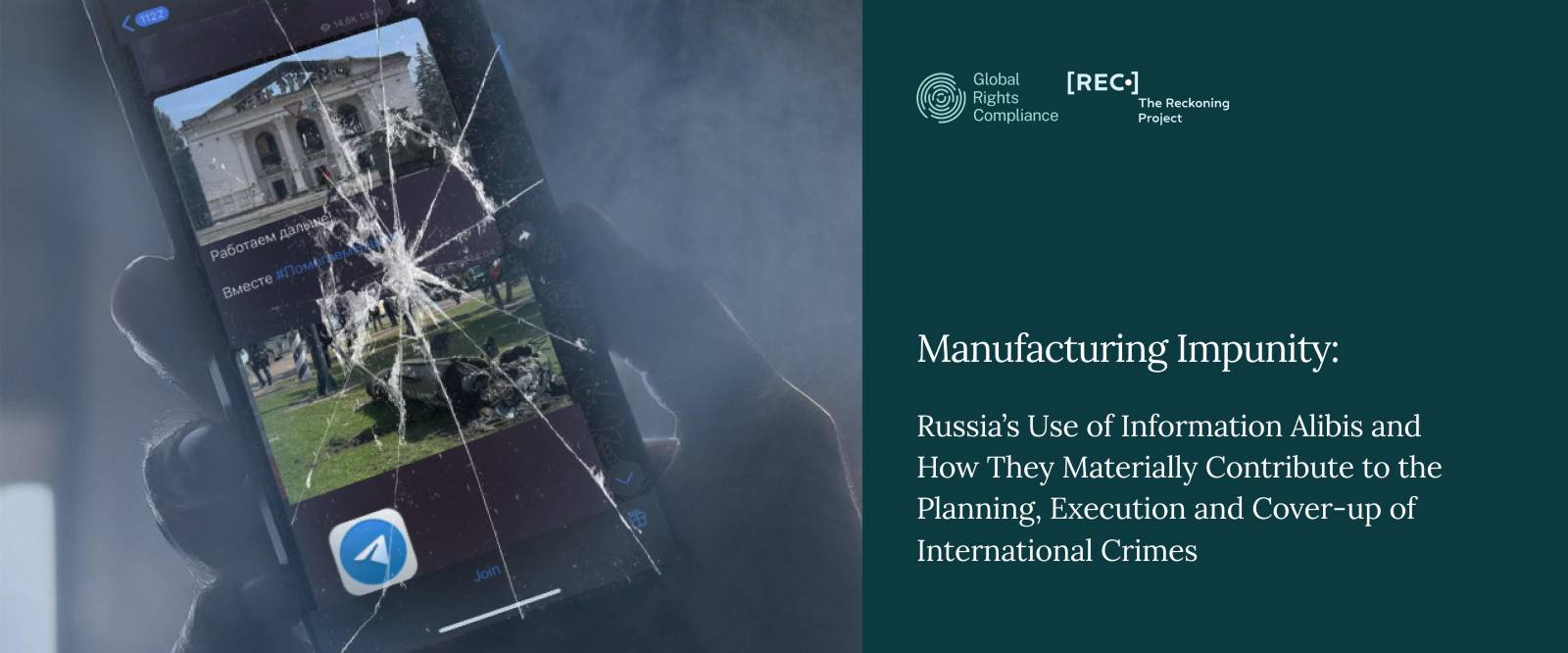
Manufacturing Impunity: Russia’s Use of Information Alibis and How They Materially Contribute to the Planning, Execution and Cover-up of International Crimes – New Report
New Report Outlines Roadmap to Prosecute Senior Russian Officials and Propagandists Behind Pre-Emptive War Crime Cover-Ups
Read the report here.
Read the summary here.
 News highlights
- New 161-page report exposes Russian calculated disinformation campaign to obscure accountability for war crimes and mislead domestic and international audiences
- Report is the first to analyse Russia’s unprecedented use of “information alibis” to distort narratives and deflect responsibility
- Disinformation campaign driven by senior Russian political figures, including President Putin and the Foreign Minister Lavrov
- High ranking government and military officials, government-affiliated NGOs, and diplomats also identified as key drivers
- In some cases, information alibis were planted up to a year before attacks took place
- More than 100,000 social media pages and vast network of popular Telegram channels used to spread false narratives about Ukraine
- Popular TV hosts reportedly received instructions on manipulating Ukraine war coverage directly from Putin
- Deadly link between information alibis and high civilian casualties
- Report offers roadmap to prosecute senior Russian officials and propagandists responsible for war crime cover-ups
- Report comes as Russia surpasses grim milestone of over 183,000 documented war crimes since its 2022 invasion
Today, a new report, Manufacturing Impunity: Russian Information Operations in Ukraine – Russia’s Use of Information Alibis and How They Materially Contribute to the Planning, Execution and Cover-up of International Crimes, released by international human rights foundation, Global Rights Compliance and leading advocacy organisation, The Reckoning Project has revealed unprecedented evidence exposing Russia’s systematic weaponisation of information during the full scale invasion of Ukraine, which is designed to conceal international crimes and obscure efforts to hold perpetrators accountable.
The new 161-page report is the first to analyse Russia’s use of “information alibis” – a carefully planned technique involving the pre-emptive dissemination of false information to deflect responsibility for crimes committed by the actual perpetrator.
The report identifies top-level figures from Russia’s political leadership, including President Vladimir Putin and senior government officials, including Foreign Minister, Sergey Lavrov and Presidential administration employees, Sergei Kiriyenko, Alexei Gromov and Sofia Zakharova, as key drivers of Russia’s pre-emptive disinformation operations. The report reveals that their efforts are coordinated through a hierarchical network, where state actors actively collude with non-state entities, such as media organisations, government-affiliated NGOs including Russian government-affiliated nonprofit ANO ‘Dialog,’ and social media influencers, to actively disseminate false information ahead of an attack.
One instance analysed by Global Rights Compliance is the Mariupol Maternity Ward No.3, which was struck by a Russian airstrike on 9 March 2022. The analysis exposes a coordinated disinformation campaign orchestrated by Russia, with multiple senior officials falsely claiming the facility was being used by Ukrainian military combatantsahead of the attack.
Just a few days before the attack, Permanent Representative to the UN Vassily Nebenzia, who was appointed directly by Putin, falsely claimed that a maternity ward in Mariupol was occupied by the Ukrainian Army, with Ministry of Foreign Affairs spokesperson, Maria Zakharova parroting this line just a few hours before Maternity Ward No 3 was struck by the Russian bombs. The hospital bombing was therefore explained as a “provocation” staged by Ukraine in order to falsely accuse Russia of war crimes and scare civilians from leaving the besieged city.
The report also reveals the different channels used to disseminate the disinformation and the growing role Russian social media channels now play in the disinformation warfare. Over 100,000 social media pages, along with a vast network of popular Telegram channels have been used to spread false narratives about Ukraine[1]. A key part of this effort involves the work of Russian military bloggers, known as “voyenkors” or “Z-bloggers” and estimated to have a global audience of around 10,000,000[2], who played a fatal role in the attack on the Donetsk Regional Academic Drama Theatre in Mariupol.
Despite the word “children” visibly inscribed on the ground outside the drama theatre accommodating 1,000 to 2,000 civilians from the start of the conflict, the attack was characterised by Russia as a “provocation” staged by Ukraine to draw NATO forces into the conflict.
The report reveals that Russian military bloggers emphasised this message the day before the attack on their channels, such as Kirill Fedorov, who indicated that Ukraine was planning a new “provocation” in the aftermath of the maternity ward incident, and Dmitriy Steshin who reported Ukraine was preparing a “provocation” in the Mariupol drama theatre where it had gathered civilians in order to imitate an air strike on the theatre.
Popular Russian TV channels and high-profile presenters are also exposed as President Putin’s mouthpieces, actively creating information alibis. A US indictment issued in September 2024 against Channel One host Dimitri Simes, claims he received instructions on issues related to the Russia-Ukraine war covered in his TV show from the Ministry of Foreign Affairs, the Russian Security Council and President Putin directly.
Before the infamous Kakhovka dam attack on 6 June 2023 perpetrated by Russia according to various independent investigations, the report reveals that in October 2022 Permanent Representative of Russian Federation to United Nations Vassily Nebenzia submitted a letter to the UN Secretary-General and the President of the UN Security Council, addressing the “plans of the Kiev regime to destroy” the Kakhovka HPP through a mine attack or massive missile strike.
Adding to this, in May 2023 Telegram channel “War of Fakes” related to government-affiliated ANO “Dialog” falsely claimed that “Ukrainian propaganda deliberately distorts information [that Russia continues to dump water uncontrollably at the Kakhovka HPP] taking it out of context in order to portray Russia in a negative light”. Another Telegram channel ANNA-NEWS which belongs to a network of Russian propaganda and disinformation media, and has ties with Russian security services posted a video with the description “[w]ho is trying to flood the Dnipro banks? One of the techniques of Ukrainian propaganda is to accuse the enemy of what you do yourself. How Ukrainian propaganda attributes its actions to the Russian side […]”.
The report reveals that some Russian disinformation strategies emerged over a year before the attack highlighting the calculated nature of the attacks.
Many of the attacks analysed by Global Rights Compliance using information alibis resulted in increased civilian casualties. The 8 April 2022 Kramatorsk train station attack reveals how Russian disinformation campaigns laid the groundwork for a strike that killed 60 civilians, despite clear evidence that the station was being used for evacuations. By falsely accusing Ukraine of using human shields and suggesting an imminent conflict, Russia created an information alibi that masked responsibility and enabled the deliberate targeting of civilians.
Another group targeted by Russian disinformation are Ukrainian POWs who surrendered after the siege of Mariupol. Starting in April 2022, Russian bloggers published videos of captured soldiers “confessing” to war crimes, likely under pressure or torture. After the Azovstal defenders were en masse transferred to Olenivka prison in May 2022, Russian sources accused Ukraine of planning to shell the facility to silence witnesses of alleged war crimes allegedly committed by the Ukrainian Army in Mariupol. Kremlin-linked bloggers even claimed Ukraine was working with British MI6 to eliminate the POWs using HIMARS missile and subsequently pin the blame on Russia. On 29 July 2022, 54 Ukrainian POWs were killed and over 150 injured in an explosion at Olenivka penal colony, with Russia blaming Ukraine of the incident. Since then, Russia has failed to allow an independent investigation to visit the site.
Alongside the detailed information alibis analysis, the report sets out a new legal framework that concludes that information alibis, when used to plan, execute or conceal international crimes, can be legitimately restricted under international law. The analysis highlights the distinction between protected speech, even if objectionable or inaccurate, and speech that may contribute to the perpetration of international crimes, underscoring the importance of recognising the need for legitimate restrictions to prevent the abuse of freedom of expression in information warfare.
Through a five-step investigative process, the report also offers a pivotal blueprint which can now be applied across various investigative contexts and used to pursue charges under the Rome Statute against individuals involved in disseminating information alibis, including senior ranking Russian officials.
Wayne Jordash KC, President of Global Rights Compliance, commented on the new report: “It is essential to differentiate between freedom of expression and deliberate contributions to criminal plans and crimes. Russia’s propogandists often cross that line, intending their propaganda to materially contribute to the planning, execution, and cover-up of international crimes.
Those who knowingly disseminate this type of propaganda intending to facilitate war crimes and/or crimes against humanity and in fact doing so should be aware that one day, along with others who use other types of weapons, may too find themselves facing accountability for their actions.”
Anastasiia Vorobiova, Legal Advisor at Global Rights Compliance, said: “By uncovering the Russia’s calculated use of disinformation and information alibis as a weapon of war, this report serves as a crucial blueprint for holding perpetrators accountable—offering a foundation for the legal prosecution of those orchestrating and disseminating false narratives to justify acts of aggression.”
“We urge the international community to contribute to efforts to counter disinformation masterminded by the Russian state and propagandists, and ensure justice for war crimes committed against the people of Ukraine.”
The report was made possible with the support of the Open Society Foundations.
Authors:
• Wayne Jordash KC, President of Global Rights Compliance
• Scott Martin, International Lawyer at Global Rights Compliance
• Peter Pomerantsev, Chief Editor, Co-founder of The Reckoning Project
• Anastasiia Vorobiova, Legal Advisor at Global Rights Compliance
• Nadiia Vaskivska, Legal Advisor at Global Rights Compliance
• Vitalii Zhuhai, Coordinator of the Propaganda Project at Global Rights Compliance
About Global Rights Compliance’s Mobile Justice Teams (MJTs)
Global Rights Compliance’s MJTs comprise a combination of Ukrainian and foreign expert investigators and lawyers, support the OPG through:
- Providing a range of legal, investigative, forensic, and transitional justice expertise in the field where crimes occurred, and where the OPG and investigators work.
- Subsequent case building rests upon a range of expertise, including trauma-informed and survivor-centred methodologies, the effective interviewing of witnesses and victims, the preservation of crime scenes, the forensic examination of ballistics and missile strikes, open-source intelligence gathering, the identification of IHL violations, crimes against humanity, and genocide, and the collation of a wide range of diffuse circumstantial evidence to build cases against the top political and military leadership.
- Coordination and collaboration between national authorities, civil society, and international partners to ensure a comprehensive and holistic approach to justice.
Mobile Justice Teams (MJTs)
The Mobile Justice Teams (MJTs) have emerged as the leading component of support for Ukraine’s justice system as it attempts to process innumerable violations of international law before and during Russia’s full-scale invasion in February 2022. This illegal aggression has resulted in extensive violations of international humanitarian law (IHL) and international criminal law (ICL), including war crimes, crimes against humanity, and potentially genocide. These violations have concurrently significantly damaged Ukraine’s legal infrastructure, limiting its (already under-resourced) capacity to investigate and prosecute these grave crimes. The response to this legal crisis has been, in part, led by an international collaborative effort, namely the Atrocity Crimes Advisory Group for Ukraine (ACA), designed to support the Office of the Prosecutor (OPG) and associated investigative agencies, pursuant to which the MJTs operate as the principal, on-the-ground, partner of the ACA.