

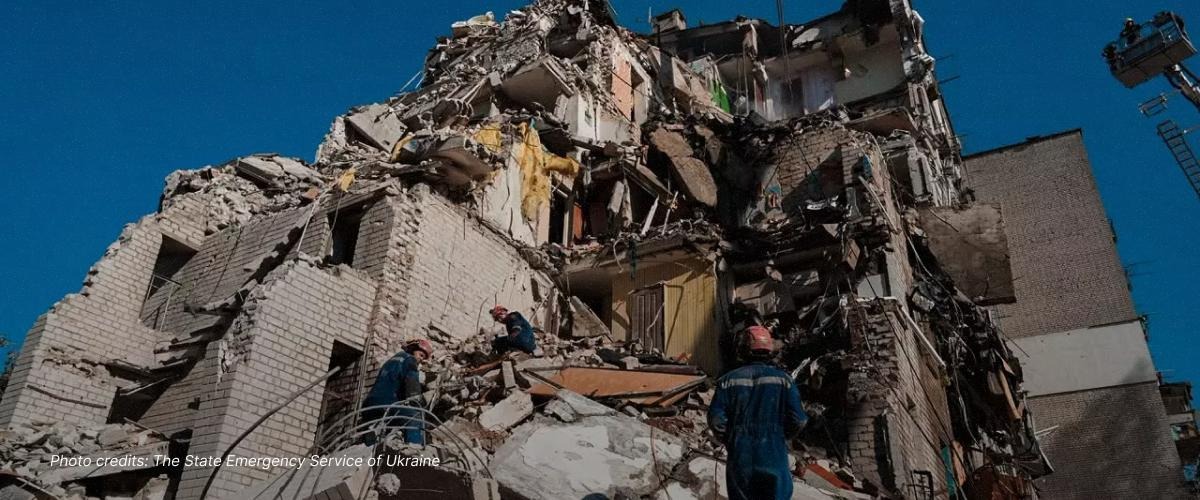
Overnight, a massive Russian missile and drone attack on Kyiv killed 22 people and injured at least 100 others, damaging residential buildings and civilian infrastructure as rescue operations continue. As Ukrainian civilians and civilian infrastructure continue to face devastating Russian attacks, the urgency of preventing resources from supporting Russia’s military complex remains as high as ever.
Yesterday, during his visit to Dublin, President Volodymyr Zelenskyy urged Ireland to swiftly conclude its investigation into alumina exports from the Russian-owned Aughinish Alumina refinery, warning that every tonne of raw material reaching Russia strengthens its capacity to wage war against Ukraine.
Despite undertaking notable lobbying efforts in 2018 to ensure that Rusal was removed from US sanctions lists, the Irish Government has known for almost a decade the links between the refinery in Shannon and Oleg Deripaska and the role of this heavily sanctioned Russian oligarch in the manufacture of military weaponry.
Zelenskyy’s speech comes at the same time as the publication of a 73-page judgment by Swedish tax authorities, which determines that the arrangement (to reduce Deripaska’s controlling share), which enabled Ireland to lobby for the removal of Rusal from US sanctions lists, was a fiction. The judgment concludes that Deripaska retains the control of EN+, Aughinish Alumina’s parent company. Swedish tax authorities consider that Rusal, which operates the refinery, should be subject to EU sanctions. This development follows growing unease over continued alumina exports to Russia despite concerns that the material finds its way to Russian smelters that are heavily implicated in the production of aluminium and its onward supply to sanctioned weapons manufacturers who are critical links in Putin’s military machine.
Stating that Ireland does not want material produced at an Irish plant to support Russia’s war machine, Irish Prime Minister Micheál Martin confirmed that an investigation into these issues is nearing completion. Once finalised, the findings will be discussed with the European Commission.
The Business, Conflict and International Crimes Hub at GRC examines how supply chains can become complicit in international crimes and why businesses and states must undertake heightened, conflict-sensitive human rights due diligence to ensure their operations are not linked to violations of international law. Under Article 25(3)(c) of the Rome Statute, the director of the refinery can be held liable if its practical assistance has a substantial effect on the commission of the underlying crime, and has the knowledge, or awareness of a substantial likelihood, that the assistance would be used that way.
Thus, at the very least, given the heightened risks of complicity in war crimes and crimes against humanity in Russia’s widespread and systematic attack on civilians in Ukraine, this must involve more than the mere auditing risks but must also include an independent and impartial investigation to robustly assess the risks and any violations and associated harm.
Putting the sanctions issue aside, on its face, the Irish Government and the company appear to have failed in their basic obligations to assess these risks, let alone manage them. The Irish Government’s investigation is welcome, but it may well be a case of better late than never.
GRC will continue to follow developments and contribute its legal expertise to discussions on responsible business conduct in conflict-affected environments.